Key insights this month:
CreditorWatch’s October Business Risk Index shows Australian retailers are heading into their biggest trading period in a weaker financial position than most other sectors of the economy. All three of the key early warning signs CreditorWatch tracks for the sector (trade payment defaults, invoices more than 60 days overdue and ATO tax defaults) are running above the national average, and the gap is widening.
Peak-season cash flow can keep an undercapitalised retailer trading through December. Failure risk reappears when trading softens in January and February and that cash has been absorbed by the ongoing monthly costs that continue in this slower period.
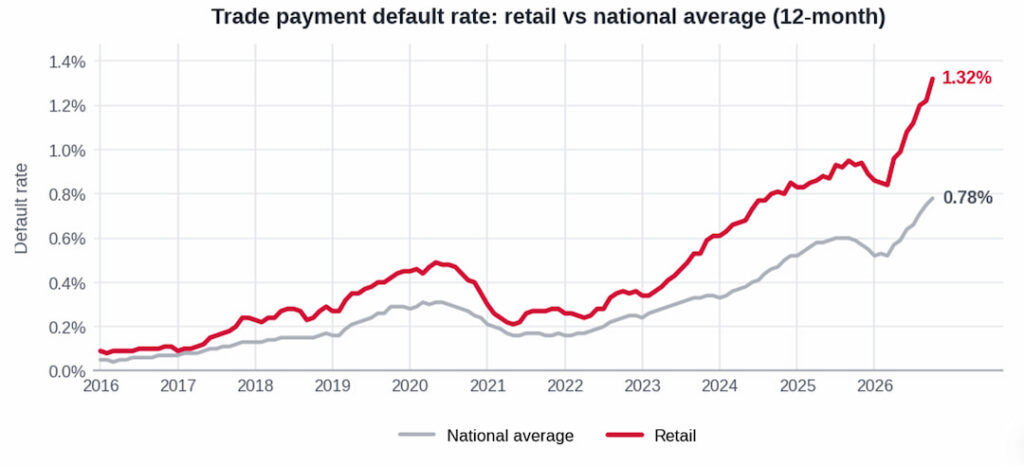
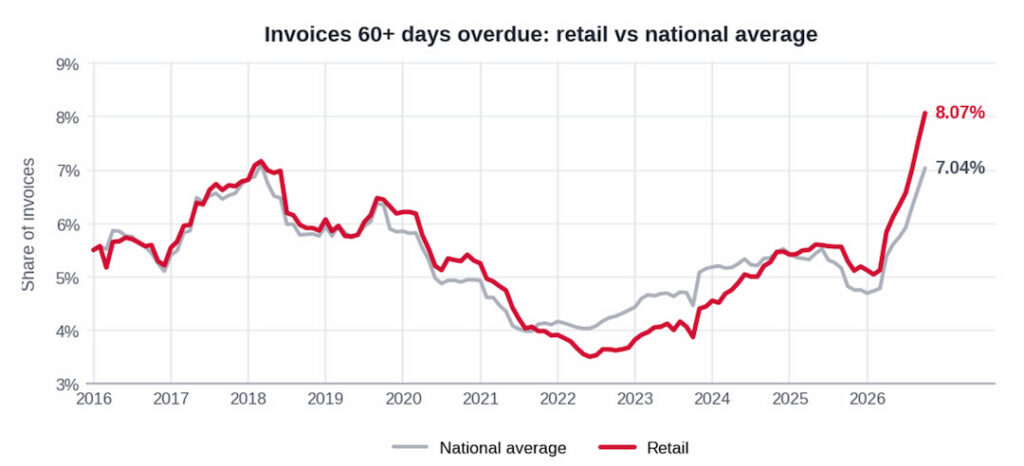
CreditorWatch CEO Patrick Coghlan says, “Black Friday will deliver strong sales for many retailers, but sales aren’t the same as cash flow. Our data shows retail trade payment default rates are up 43% in a year, and one in 12 retail invoices is now more than 60 days overdue. Those are the clearest early warning signs we have, and they’re flashing ahead of the busiest trading period of the year.
“The real test comes in January, when supplier bills for November stock fall due. Too often, it’s small suppliers who end up funding larger customers’ cash-flow problems.”
CreditorWatch Chief Economist Ivan Colhoun says, “The RBA has raised interest rates twice in five weeks and five times over 2026 to attempt to lower the rate of inflation. Together with higher wages, fuel and other costs, this squeezes business profitability, with retailers feeling something of a double impact as their customers’ are also squeezed.
“Unfortunately, to lower the inflation rate, the RBA believes a period of even slower economic growth is required, which will inevitably mean some increase in business insolvencies. Discretionary spending, interest sensitive sectors of the economy such as residential construction and real estate, will likely feel the impact first. Sectors benefitting from defence and technology spending, including parts of construction and mining, and services to these sectors (including renewables and utilities), will likely fare better”.
Retail at a glance
Retail trade payment default rate
Year on year (now 1.32%)
Businesses 60+ days overdue
Year on year (now 8.1%)
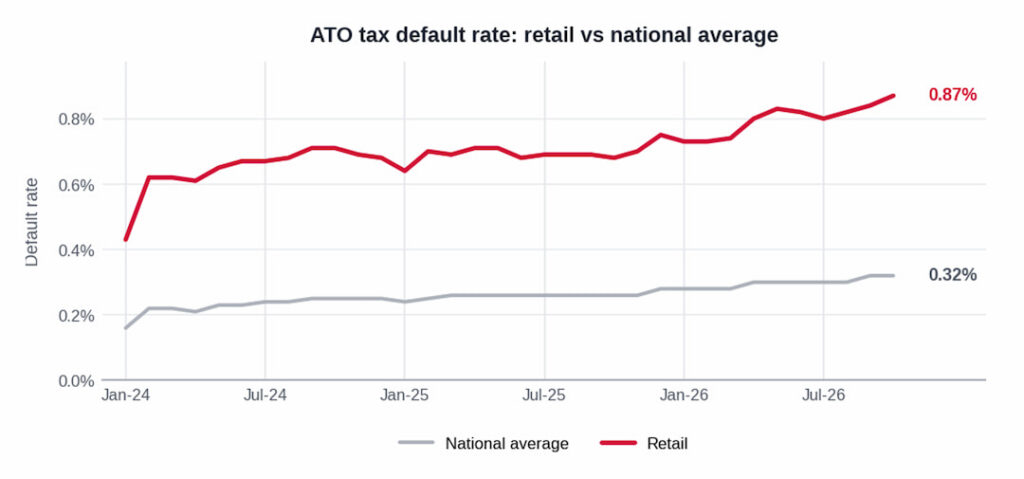
Retail ATO defaults in effect
Year on year (now 1,133)
Retail insolvencies in FY2025–26
Up from 871 to 1,006
November is (almost) the new December
More Christmas spending is being pulled forward into November with the continuing rise in popularity of the Black Friday sales phenomenon. The Australian Retail Council (ARC) reports household retail spending rose 7.0% year-on-year in November 2025, easing to 4.8% yoy in December, as households increasingly bring their Christmas shopping forward to take advantage of Black Friday discounts. This may be the year November household spending exceeds December spending.
This year, the ARC and Roy Morgan forecast a record $7.2 billion will be spent over the four-day Black Friday to Cyber Monday weekend (27–30 November), up 5.5% on last year with shoppers being more price-driven than ever.
WHY THE SHIFT MATTERS FOR CREDIT RISK
When Christmas demand moves into November, the discounting is increased. Revenue that used to be earned at full price in December is now earned on promotion, while the supplier invoices for that stock still fall due on the same 30 to 60-day terms, landing in January.
Three early warning signs, all above the national average
Trade payment defaults identify businesses that are not paying their suppliers. 60+ day arrears capture persistent late payment. ATO defaults show tax debt that has become formal and material (over $100,000 owed to the tax office). Insolvency is the eventual legal outcome, not the first signal, which is why these three measures matter most heading into peak season.
Retail trade payment defaults at a record high
Retail late payments flip from better than average to worse
WHAT THIS MEANS FOR BLACK FRIDAY
Persistent arrears change supplier behaviour. Shorter terms, lower credit limits and deposit requirements can drain liquidity exactly when a retailer needs to cover utilities, rent, returns and wages.
Retailers have less room to manoeuvre on tax
Retail insolvencies: the next wave may be deferred, not avoided
Black Friday is designed to turn stock into cash. This year, that conversion appears riskier. Sales may rise, but heavy discounting squeezes margins, while rent, wages, fuel, tax and supplier bills on 30 to 60-day terms keep their full value, and many of those bills fall due in January, when demand is softer.
Subsectors to watch
How a successful sale becomes a January cash-flow trap
THE TEST
If January supplier payments hold, Black Friday has strengthened the business. If they slip, the sale may simply have shifted risk from the retailer’s inventory to its creditors.
Retail is the sharp end of a wider squeeze
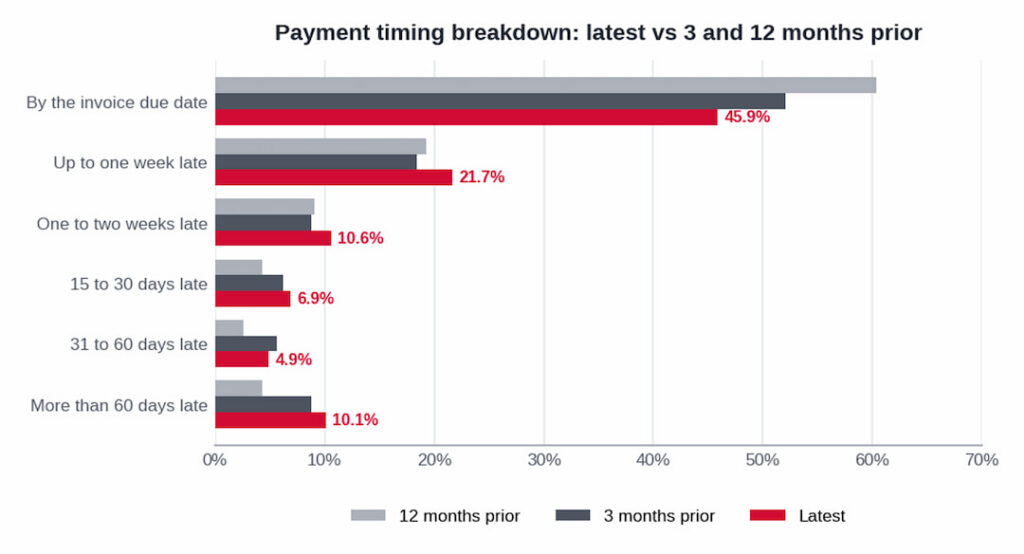
Across the broader economy, each of the three credit leading indicator CreditorWatch monitors is moving the wrong way. Just 46% of invoices were paid by their due date over the past three months, down from 60% a year ago, while one in 10 invoices is now more than 60 days late. On a 12-month average basis, 7.0% of invoices are more than 60 days overdue, up from 4.8% a year earlier.
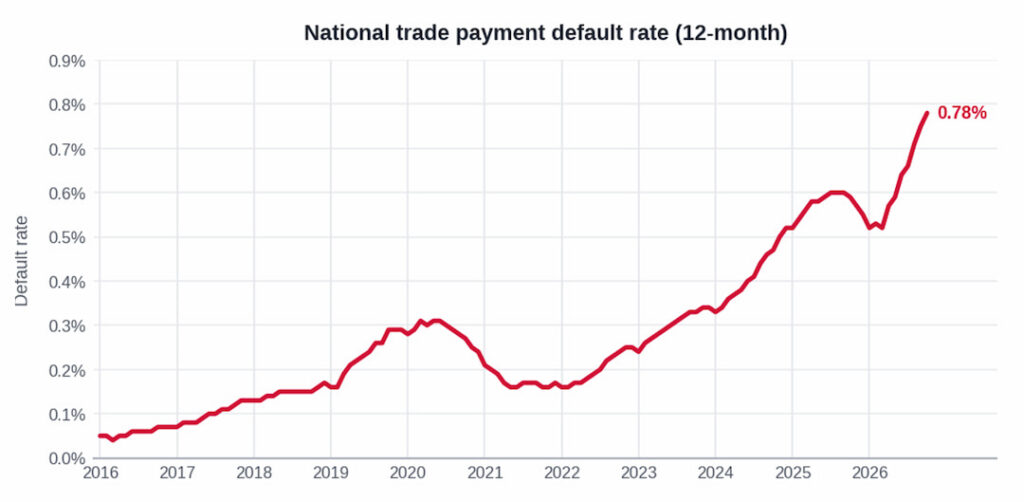
The national 12-month trade payment default rate reached 0.78% in October, up from 0.59% a year earlier and the highest level since at least 2016. The rate eased in late 2025 and early 2026 before climbing sharply from April.
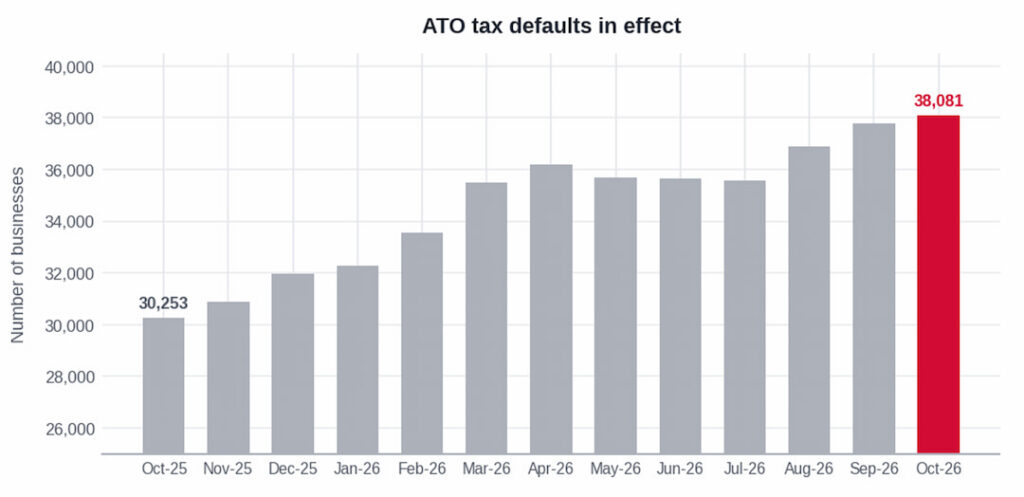
The strain is also showing up in obligations to the tax office. The number of ATO tax defaults in effect reached 38,081 in October, up 26% from 30,253 a year earlier.
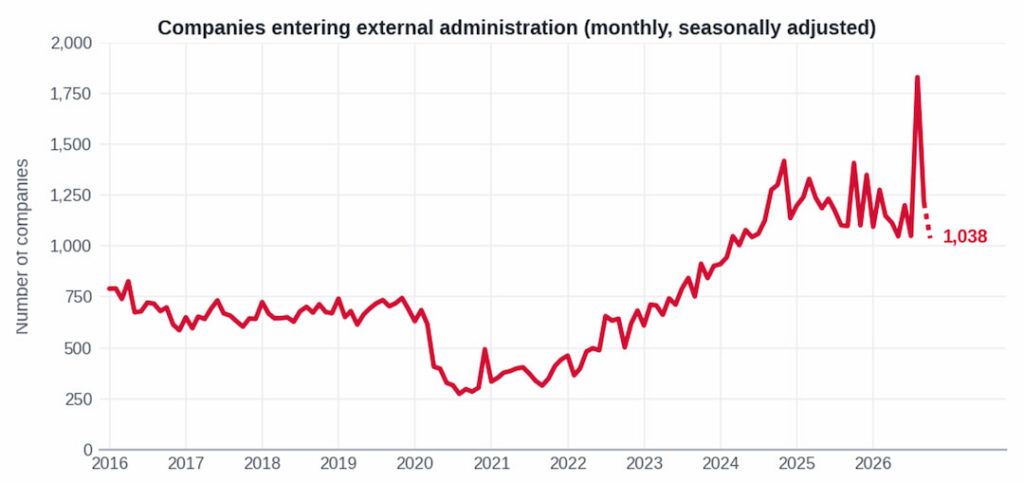
Insolvencies remain volatile. The annual insolvency rate was 0.74% in October, unchanged from a year earlier. Court actions totalled 2,150 in October, up 12% year on year, and have held above 2,100 a month since April.
Industry and regional snapshot
Our outlook
CreditorWatch Chief Economist Ivan Colhoun says, “The Reserve Bank is seeking a slower pace of economic growth to lower inflation. That will increase pressure on businesses more generally, with discretionary spending and interest sensitive sectors of the economy most impacted.
“No one welcomes this development, nor the continuing period of elevated inflation, which of course builds on the significant cost increases for households and businesses of recent years. Debate is growing about whether Federal and State governments can reduce their spending to take some pressure off inflation and interest rates.
“Thankfully, it’s likely that the RBA will now keep interest rates unchanged for an extended period while it assesses the impact on the economy. It’s possible that Australian interest rates may have peaked, however, until inflation is clearly lowered, it’s unlikely that there can be any early interest rate relief. ”