
What began as a small team chasing unpaid invoices became a new way to forecast financial risk
Fifteen years ago, CreditorWatch was founded as a result of a team of Australian small business operators encountering the same frustrating reality: you could do everything right, deliver the job on time, issue the invoice and still have no real insight into whether you’d get paid. Credit risk was something you only truly understood after it went wrong.
For Patrick Coghlan – a CreditorWatch Co-Founder and CEO since 2018 – that wasn’t just an inconvenience. This was money that business owners needed to pay their rent, mortgage and school fees. It was money out of their pockets that they could do nothing about.

“What we realised was that small and medium businesses just had to accept bad debts,” he recalls. “Because there was nothing that was available for them to access… to avoid it, or at least to minimise it.”
That founding ‘aha’ moment was remarkably simple. The earliest insight for CreditorWatch’s founders wasn’t theoretical – it came from watching the same payment behaviour repeat across businesses in the publishing industry.
“Companies would advertise [in our publications], then they wouldn’t pay their bills… then we would see them advertising in a competitor’s magazine or website,” Patrick says. “You’d speak to that publisher and they’d say, ‘Yeah, they never paid their bills’ – and it was as simple as, there’s got to be a better way.”
Rather than accept that as ‘just the cost of doing business’, the founders recognised a gap in the market and decided to do something about it. Australian businesses needed simple, affordable tools to ensure they got paid by their customers. And so, CreditorWatch was born – established in Australia, by Australian businesspeople, to serve Australian businesses.
Co-Founder and inaugural CTO, Dale Hurley, who was with CreditorWatch from 2010 to 2018, saw the same problem from a technology and cost perspective. At the time, a one-off static credit report could cost more than $100, which was too much for an SME if they were wanting to assess risk on a $5,000 job for example. The reports were also designed for experienced credit risk analysts making them almost indecipherable for non-credit professionals.
Today, more than 10,000 Australian businesses, from sole traders to Big 4 banks, use CreditorWatch to take control of their credit risk management – a scale that reflects both the persistence of the problem and the strength of the solution. It’s been quite a journey – beginning with three employees, CreditorWatch now has more than 250 staff.
In 2025 alone:
- CreditorWatch customers ran 1,125,894 credit reports
- Lodged 33,922 payment defaults
- Monitored 3,161,360 trading partners for important changes
- Received 1,539,544 risk alerts
For customers, that scale translates directly into confidence. As Gavin Gilbert, Managing Director at Slabmaster, puts it: “Once you’ve used CreditorWatch, you can’t live without it. The data is deep, the insights are accurate, and it gives us confidence in every credit decision.”
Early days: building a new solution
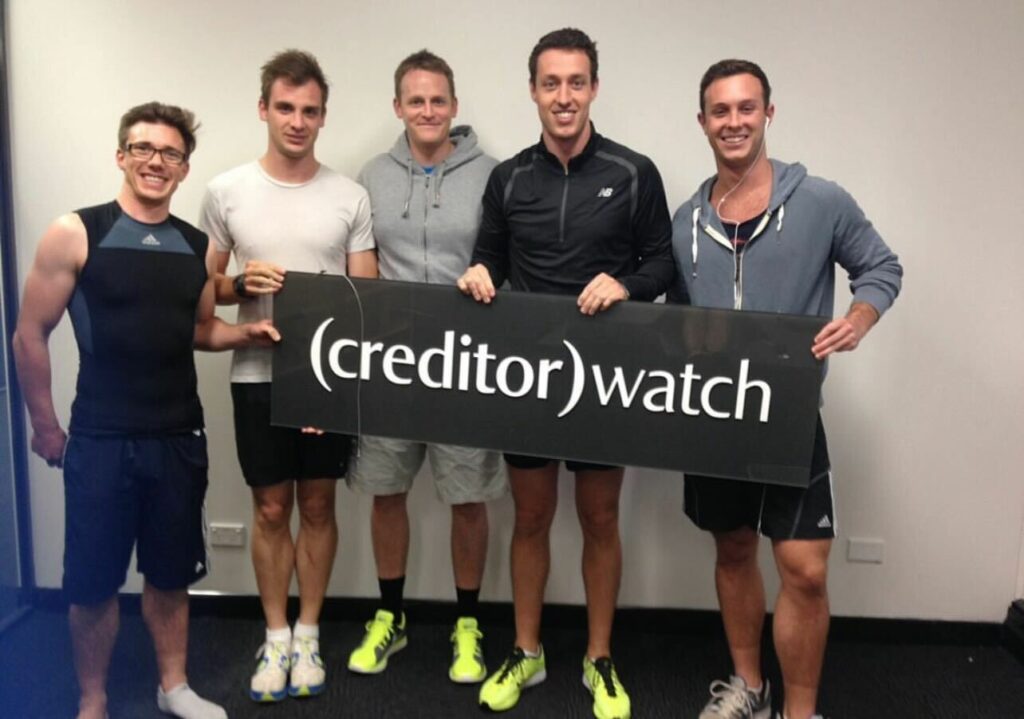
When Charles Kinsella, now Head of Corporate, Expansion and Retention, joined CreditorWatch in 2012, the company was operating out of its first North Sydney office with a tiny team and a big idea.
“There was only six of us,” Charles recalls. “It was my first real job – I didn’t even know what a credit report was. But I really liked the founders, and there was this exciting, tightknit atmosphere.”
In those early years, everyone wore multiple hats.
“I was sales, support, customer service, admin, marketing – you name it, we did it,” he says. “You’d talk to a customer, then try to get something built for them on the same day!”
From a technology perspective, Dale says those early constraints were important drivers of innovation. With no legacy systems and limited resources, the team focused on automation, cloud infrastructure and real-time data publishing – dramatically reducing costs and removing manual processing that slowed incumbents down.
“We really used our constraints as strengths,” Dale says. “We didn’t have massive teams or budgets, so we had to be laser-focused on automating everything and delivering value very, very quickly.”
Winning with innovation
The closeness to customers shaped CreditorWatch’s earliest innovations – and it remains a defining part of how the company approaches product development. Patrick describes it as a product culture that was customer-led from day one: “We’d spend a huge amount of time with the industry, understanding what they wished the offering looked like. That customer product feedback was just so valuable, and is what really drove the innovation.”
Dale agrees, noting that product ideas often came directly from customer conversations, embedding a culture of speed, responsiveness and practical problem-solving that still defines CreditorWatch today.
“[Onboarding tool] ApplyEasy didn’t exist when I started,” Charles says. “It came directly from customer feedback. We’d talk to customers, then go back to our dev team of one person [CreditorWatch now has more than 100 people in the engineering team] and say, ‘Can you build this? Because the market needs it.’”
From the outset, CreditorWatch knew it couldn’t out-muscle the established multinational bureaus on raw data volume. Instead, it pioneered monitoring and changing how credit information was consumed.
“At the time, customers were still using PDFs or paper-based reports. Monitoring was incredibly expensive and not accessible to most businesses,” Charles says. “We made it affordable for everyone, and that changed everything.”
Patrick frames that shift as the moment CreditorWatch started reshaping the category – moving from point-in-time checking to always-on insights: “It’s all well and good doing a credit check, which is a point-in-time check. But what happens tomorrow, next month, next year? That’s really the valuable bit going forward.”
Over time, that approach created a powerful network effect. Today, CreditorWatch customers have placed 23.4 million monitoring watches on businesses, generating real-time behavioural signals that strengthen the entire ecosystem and improve risk visibility for everyone in it.
And while the early competitive edge was product and service, the long-term edge has become something harder to replicate: uniquely broad, uniquely local data that reflects how Australian businesses actually pay each other – not just what shows up late in the cycle.
Patrick explains that data on small businesses is key to identifying risk early: “Data just from the top end of town, from the banks, is quite late in the piece… By the time a debtor has stopped paying a bank or a telco, they’ve already stopped paying every other business… We knew the importance of having what we would call a 360-degree view… how small pays small, big pays small… across construction, hospitality, manufacturing.”
For partners embedding CreditorWatch directly into their workflows, that depth and reliability is critical. As Richard Winkett, Co-Founder of CitoPlus, explains: “If the data isn’t available, our brokers can’t do a deal. Reliability and stability of CreditorWatch’s APIs are absolutely key. Beyond that, the alignment in mindset and their SME-focused data made them the right partner for us.”
Scaling up without losing the culture
When Matt Jackson, now Chief Revenue Officer, joined in 2012, CreditorWatch was still finding its feet commercially.
“They were just trying to help customers get paid in the really early days,” Matt says. “Then it quickly evolved to making credit reporting affordable for everyone.”
Trust was hard-won.
“Brand name was a big challenge. People trusted the incumbents, and we were the new people, but usability proved decisive. CreditorWatch was easy to use – I knew from day one it was going to be successful.”
Both Matt and Charles point to culture as a constant through growth.
“There was no ‘that’s not my job’ mentality,” Charles says. “We were all in it together. And that still exists 15 years later with 250-plus staff.” “Culture is the reason I started at CreditorWatch and the reason I’m still here,” Matt adds.
Patrick agrees, and credits deliberate hiring, plus an employee-led ‘all in’ mindset that has scaled with growth in the business: “We were up front that that’s how the business worked… The more employees you’ve got thinking that way, the next set of employees come on and they go, ‘Oh, okay, this is how it works. We all pitch in everywhere. We all want to win.’”

The industry view
From outside the organisation, Nick Pilavidis, CEO of the Australian Institute of Credit Management (AICM), has watched CreditorWatch’s rise first-hand both as an early customer and then in his role at the AICM.
“I remember the first conference where CreditorWatch was exhibiting – the new innovator startup on the block,” Nick says. “To see it evolve into a real industry leader has been exciting.”
Nick highlights CreditorWatch’s responsiveness and credibility.
“They’re consultative, not one-size-fits-all. And they’ve been very present in regulatory change, supporting the profession as the industry evolves.” CreditorWatch has been involved with the AICM for over 10 years now, sponsoring events including the Young Credit Professional of the year which fosters the next generation of credit talent in Australia.

The power of predictive data
As CreditorWatch matured, so did its data, enabling a transformative shift in 2018 from backward-looking reporting to a predictive risk intelligence model.
“When I first joined, we didn’t even have a credit score,” Charles says. “We were upfront about what we had. Now, we’ve got years of data that’s contributed to the most predictive credit score in the market. It takes time to build a market-leading data set.”
That evolution was vital for adoption for larger businesses such as financial institutions and insurers.
“The move to a mature, predictive RiskScore was a watershed moment,” says Stirling Streeter, Enterprise Account Director, who joined CreditorWatch in 2018. “It put us on the map with enterprise customers.”
From a technology perspective, Arun Baghel, Senior Engineering Manager, who joined in 2017, agrees. “You can’t just spin up this kind of data. It accumulates over years, and that’s a real advantage.”
Patrick puts it even more bluntly: the real value isn’t just ‘more data’ – it’s different data, built through network effects across industries and business sizes. “We didn’t appreciate the significance of the network effects we were creating… Having the same amount of data, but from a cross section of all types of businesses… that’s what’s powered not only the growth of the data, but the insights that come out of it.”
And in the last few years, those compounding effects have started to show up decisively in competitive comparisons. “When our data is put head-to-head… there’s clear differentiation and clear superiority in our data, and as a result the largest companies in Australia are moving to CreditorWatch and trusting our data for their decisions,” Patrick says. “Companies are actually testing that data… and reporting back to us to say that the data is truly different and significantly more predictive.”
Credibility at enterprise scale
As CreditorWatch matured, so did the organisations relying on it.
“Getting MSAs signed by a number of major banks has been a huge milestone,” Matt says. “It shows the data is trusted at the highest level.”
Enterprise-ready datasets, automation and digital workflows helped CreditorWatch move from challenger to core infrastructure, while retaining its original focus on practicality and accessibility. This shift also reflects CreditorWatch’s strategic narrative today: moving the market from seeing credit risk as a one-off ‘check’ to understanding it as always-on, predictive risk intelligence, powered by real-time payment behaviour and early-warning signals.
Fifteen years in, and still disrupting
Today, CreditorWatch employs more than 250 people, supports businesses of all sizes and provides risk intelligence to major financial institutions and ASX-listed companies. Yet, as Charles notes, the founding mindset hasn’t changed.
“We competed through technology, innovation and customer experience,” he says. “And that’s still true today – even as we invest heavily in AI and automation.”
Patrick emphasises that the investment is deliberate, and substantial. “We’ve got customer advisory councils, regular feedback sessions with our customers, and we’ll spend about $18 million on innovation in FY27,” he says. “What you see today will be very different to what you see and use in 12 months.”
Looking ahead, Patrick believes the next era of best-practice credit management will be defined by visibility and accessibility — not just inside a single platform, but wherever customers make decisions. “CreditorWatch data will be able to exist anywhere… within ERPs… or within the LLMs that our customers use… regardless of what a customer is using CreditorWatch data will be available,” he says, describing a platform-agnostic, AI-enabled vision where risk intelligence can be pulled into workflows.
Fifteen years on the same vision remains as CreditorWatch empowers 10,000+ Australian businesses to trade confidently with their customers. But they are doing so with deeper data, smarter technology, and a clearer view of what’s coming next.
Frequently Asked Questions
The founders of CreditorWatch saw that Australian businesses had very little visibility over who would actually pay their invoices, and often only understood credit risk after something had gone wrong.
Many product ideas came directly from customer conversations, helping CreditorWatch build monitoring, onboarding and predictive credit tools that met practical business needs.
It says CreditorWatch is investing heavily in innovation and expects its data to become available wherever customers make decisions, including within ERP systems and AI tools.

Get started with CreditorWatch today
Take your debtor management to the next level with a 14-day free trial.