
Key insights this month:
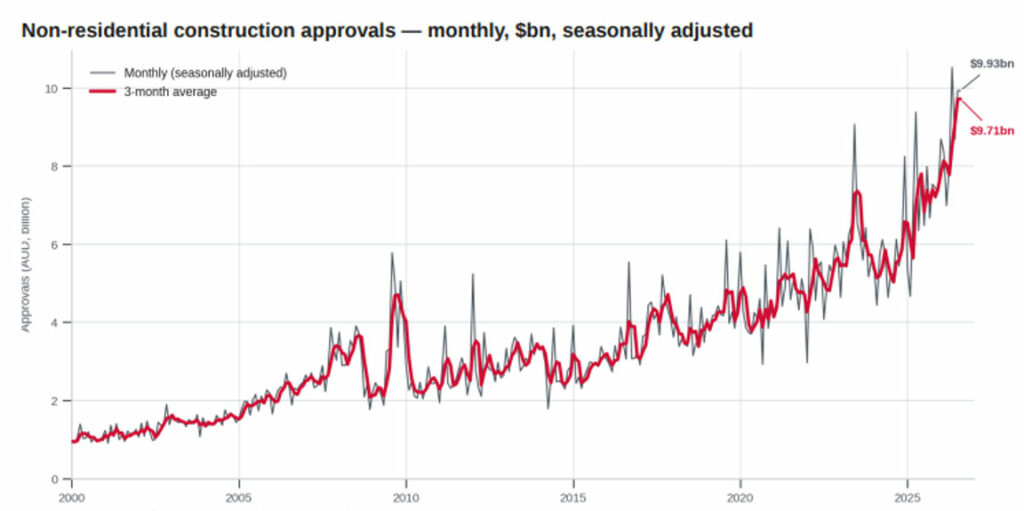
CreditorWatch’s August Business Risk Index results reveal Australia's data centre boom is quickly becoming a construction story as much as a technology story. Australia is now the world's third-largest destination for data centre investment, with a development pipeline out to 2030 worth more than $150 billion.
New South Wales and Victoria at this stage account for some 91% of the future pipeline according to CommBank, concentrating much of the resulting demand for land and labour in two of the country's busiest construction markets.
For commercial builders, engineering firms and specialist subcontractors, the opportunity is substantial. Data centres require extensive electrical, mechanical, communications, cooling, controls, fire-protection and commissioning work. Their construction therefore creates demand well beyond conventional structural building packages, benefiting electrical contractors, mechanical-services businesses, civil contractors, specialist engineers and suppliers of highly specified equipment and materials.
CreditorWatch CEO Patrick Coghlan says, “A $150 billion pipeline is being poured into a construction sector that's already seeing credit pressures running at two speeds. The commercial firms geared to data centre work are looking at years of high-value activity, but the residential end is still absorbing rising defaults, tight cash flow and higher input costs.
"The risk is that this boom draws skilled labour and materials away from housing and essential infrastructure at exactly the time we can least afford it. Australia doesn't have a shortage of demand for construction - it has a shortage of capacity to deliver it. That's the real test the numbers are pointing to.
"Approvals tell you where the money wants to go. They don't tell you whether an industry has the workforce, the supply chains and the balance-sheet strength to build it. That gap is where the pressure will show up first."
What CreditorWatch's data reveals beneath the boom
For commercial and non-residential builders, this pipeline is unambiguously good news - a multi-year source of high-value, specialist work. But CreditorWatch's data reframes what it means for the construction industry as a whole, because the boom is landing on a sector that is already displaying quite different credit characteristics.
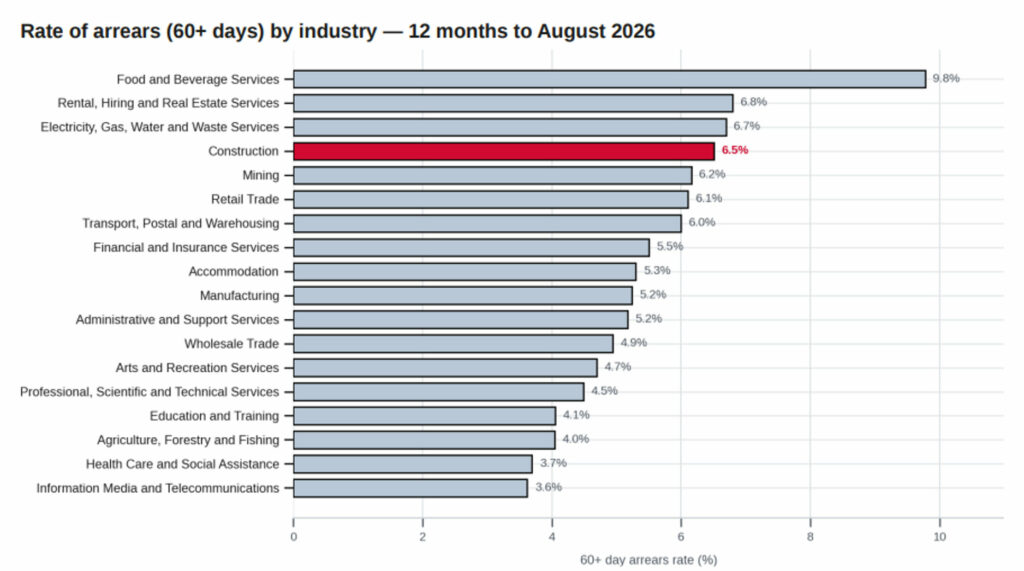
The August 2026 Business Risk Index shows construction - measured across the whole industry - carrying a 60-plus-day payment arrears rate of 6.5%, the fourth highest of the 18 industries CreditorWatch tracks, with arrears up 13.3% over the year.
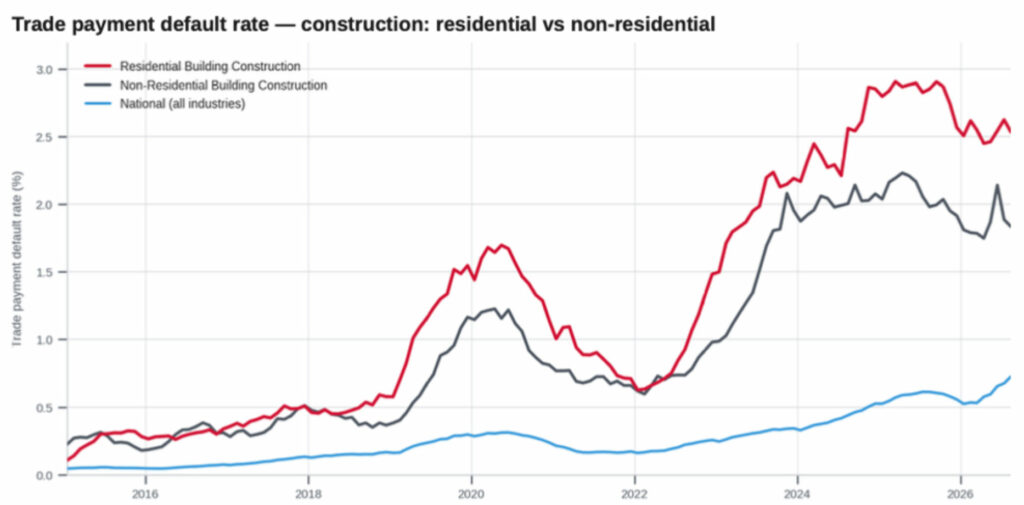
Much of that strain is concentrated in the residential end of the industry, not the commercial work the data centre pipeline will feed. The housing-market downturn of the past six to nine months - and a number of high-profile residential builder failures - sit behind construction's third-highest trade-payment default rate of any industry (at 1.94%) and its second-highest ATO tax-default rate (1.58%). These are the pressure points CreditorWatch's data is picking up in the parts of construction the boom won't rescue.
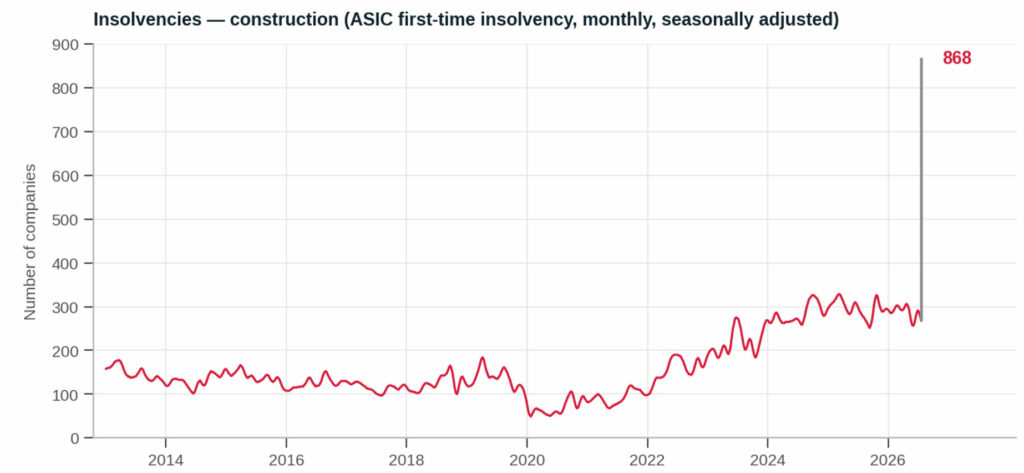
That strain has become sharper in the most recent data. Construction first-time insolvencies rose to 868 in August, well above the level of around 300 a month that had prevailed through much of the past year. The increase is concentrated in residential building - the segment already carrying the industry’s highest arrears and default pressures - and so reinforces, rather than changes, the picture CreditorWatch’s data has been showing: it is the housing end of construction, not the commercial and infrastructure work the data centre pipeline will feed, that is under the most acute pressure.
That is likely the real significance of the data centre build-out. It does not lift all of construction evenly; it draws finite labour, specialist trades and materials towards premium commercial and infrastructure work, and, in doing so, competes for the same resources that residential builders need. For an already-stressed housing-construction segment, the boom risks adding to cost and capacity pressures rather than relieving them, raising credit risk given the somewhat sequential funding nature often employed by smaller residential builders.
The latest data points the same way. Construction insolvencies have stepped sharply higher, while more builders are also seeing trade payment defaults registered against them and an increasing number are defaulting on their tax payments. Together these signals suggest further near-term insolvency risk in the sector, even as the larger pressures suggested by the data centre boom continue to build.
Why trade payment defaults are the number to watch
CreditorWatch's analysis shows why these payment metrics deserve more attention than any approvals headline, for commercial builders scaling up, and for residential builders competing for the same resources. A trade payment default is a leading indicator of insolvency - payment problems emerge earlier in the distress cycle than formal failure, giving suppliers and credit teams a window to act. Smaller builders are less resilient to higher interest rates than large builders, while the improvement in recent years likely reflects the positive impact of 2025’s interest rate reductions (since reversed).
CreditorWatch's data quantifies the signal precisely: a business with four or more registered trade payment defaults carries an insolvency rate of around 19%, against well under 1% for a business with none.
That predictive power is of critical importance in a data centre context. These packages can offer scale, continuity and higher-value specialist work, but they also expose contractors to long delivery schedules, labour scarcity, procurement delays and cost escalation. A firm that expands too quickly, prices work poorly or runs short of working capital can post rising revenue while its cash position quietly deteriorates. And because the boom bids up wages and materials industry-wide, that same cost pressure flows through to residential builders who are not sharing in the commercial upside - the segment where CreditorWatch's data already shows the greatest strain.
The opportunity and the capacity test
CreditorWatch's data suggests the boom will widen the gap already visible in its numbers between the two parts of the industry. Well-capitalised commercial and infrastructure builders, those with specialist capabilities, those who select projects carefully and have the balance-sheet strength to manage technically complex contracts, could capture a multiyear expansion in digital infrastructure.
Residential and less-capitalised contractors, meanwhile, face the downside of the same boom without the upside: higher wages, more expensive materials, skilled labour shortages and heavier working-capital demands, on top of the arrears, defaults and tax-default pressure CreditorWatch's data already records in the housing-construction segment.
The opportunity is enormous, but so is the capacity test. Australia will not capture the full economic value of data centre investment simply by approving more facilities. It will need to expand the skilled workforce and supporting infrastructure quickly enough to build digital capacity without drawing labour and materials away from housing, energy, transport and other essential construction. As CreditorWatch Chief Economist Ivan Colhoun explains, that tension is one local expression of a much larger set of forces now reshaping the entire operating environment.
Economic backdrop becomes more complex
The housing market downturn of the past six to nine months has attracted a substantial amount of media attention. There have been increasing reports of challenges at private credit funds and in the past month, the announcement of the administration of the large Bathla construction group.
A variety of factors are contributing to persistently high insolvencies, including high interest rates, continuing elevated costs and general inflation - both of which build on the large rises of earlier years - along with the government’s changes to taxation settings announced in the May budget. Total first-time insolvencies rose to 1,834 in August, a marked step up on recent months and among the highest monthly readings in the series, with construction accounting for a large share of the increase.
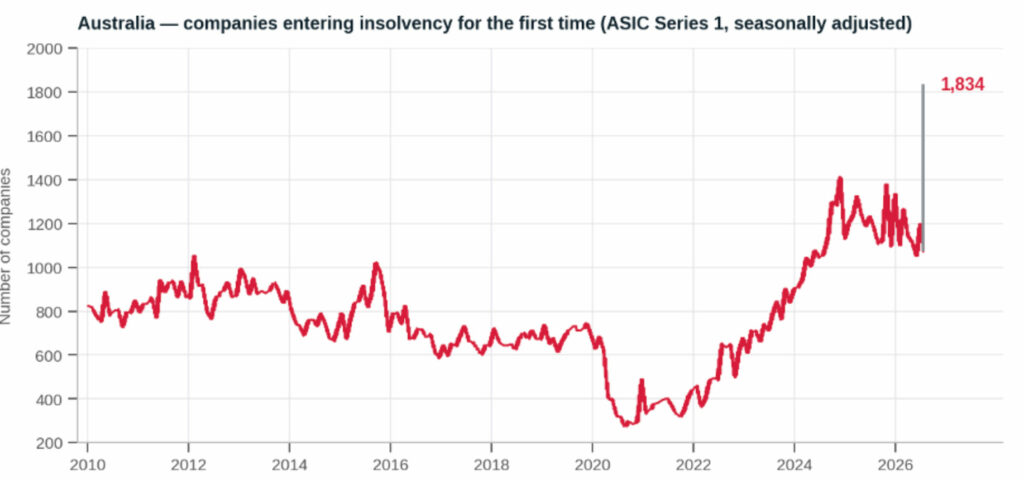
However, the collision of two even larger and broader forces - Geopolitics and the AI investment boom - seem likely to add further to these pressures, creating favourable opportunities for some businesses and sectors, but contributing to greater diversity in economic performance by sector and a more difficult overall credit environment.
Recent geopolitical developments
The collision of geopolitics and AI investment, and the impact on interest rates
Higher fuel prices related to conflicts in the Middle East and Ukraine are the key channel that most Australian businesses – and importantly their customers – are experiencing, particularly in the latest month when Australia's fuel excise subsidies ended and renewed US-Iran hostilities have seen oil prices rise back to US$100 per barrel. This adds directly to input and transport costs, as well as crimping the discretionary spending of consumers.
At the same time, the world is of course in the midst of a massive investment boom, related to the development of Artificial Intelligence, with companies and countries racing to develop their own AI for economic and strategic benefits. CommBank estimates that Australia's data centre build-out could be worth around $150 billion by 2030, with that amount multiplied many times over for the rest of the world.
While much of the discussion to date has centred around the long-term implications of AI for productivity, employment and living standards, central banks have only recently begun to focus on the nearer-term inflationary pressures that the boom will create.
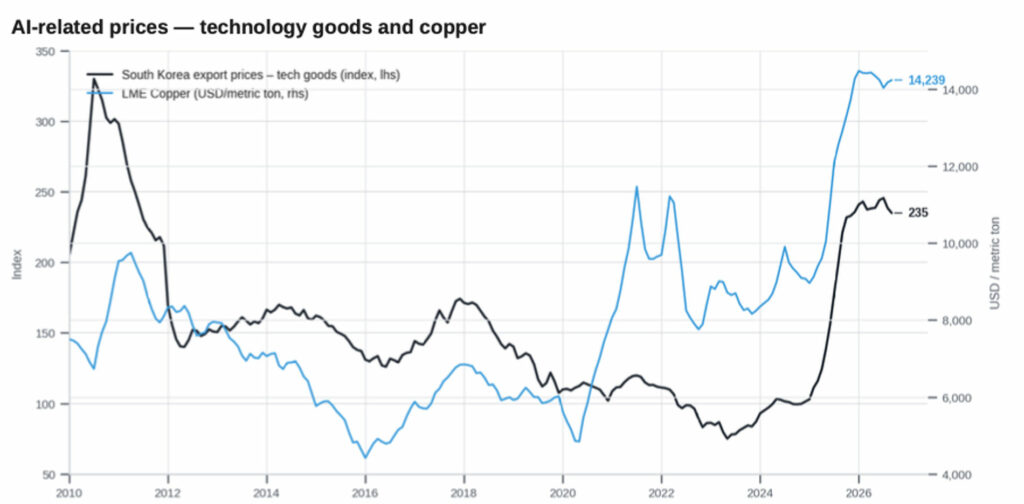
The significant increase in the value of non-residential construction approvals in recent months dwarfs that of Australia's mining boom (though higher costs are a significant consideration), while the prices of raw materials such as copper and technology inputs and outputs have risen even more sharply over the past 12 months. This is likely to result in both the US Federal Reserve and the Reserve Bank of Australia increasing their official interest rates at upcoming September meetings, given both face already above-target inflation settings.
The outlook: increasingly diverse economic performance and tighter and more difficult credit conditions
CreditorWatch Chief Economist Ivan Colhoun says this combination of forces brings about an increasingly diverse operating environment and overall, more difficult credit conditions for Australian businesses.
“Businesses have already been experiencing elevated rates of cost increase for many years and the equal highest interest rates in over a decade,” he says. “Recent increases in fuel costs, the unwise quantum of this year's Minimum Wage increase and a prospective further interest rate rise in September, will add to these pressures.
“The winning sectors are likely to be parts of Mining, parts of Construction and other businesses that might directly benefit from the AI investment boom - businesses providing services to these sectors including Finance and Professional Services.
“At the same time, any companies with high debt loads, sectors where fuel is a significant input or transport costs are significant as well as sectors exposed to consumers' discretionary spending are likely to also face more challenging operating conditions.”