Key insights this month:
The July Business Risk Index results show the hospitality sector is under sustained financial pressure - evident in the payment data and business closures - with forward indicators pointing to continued strain in the year ahead.
More than one in eight cafés, restaurants and takeaway food businesses closed in the 12 months to July 2026, according to CreditorWatch's data. The sector's closure rate reached 12.03% - almost double the national average of 6.69% across all industries.
Put another way: of every 100 cafés and restaurants trading a year ago, 12 are no longer operating. It's a clear illustration of a sector caught between rising costs it has limited ability to control and households that are dining out less.
Warning signs showing in the payment and default data first
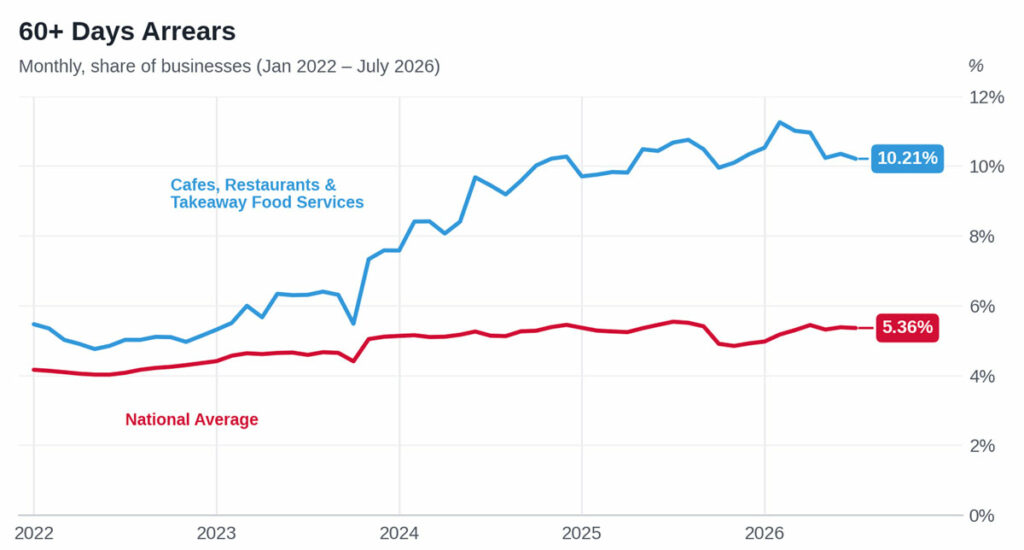
These closures were, in large part, signalled in advance. Key forward indicators, 60+ days arrears and trade payment defaults, have both been rising consistently since early 2022 with both hitting record highs in February 2026 and April 2025 respectively.
In July 2026, 10.21% of cafés, restaurants and takeaway businesses were 60 or more days in arrears on their payments - nearly double the national average of 5.36%, and the highest arrears rate of any sub-industry in the country.
That points to a clear link: a high share of hospitality businesses were already falling behind on payments well before many ultimately closed. Arrears at this level are typically more than a short-term cash-flow issue - they're a reliable early indicator that a business is under genuine financial strain. The closure figures largely reflect an arrears problem that was evident months earlier.
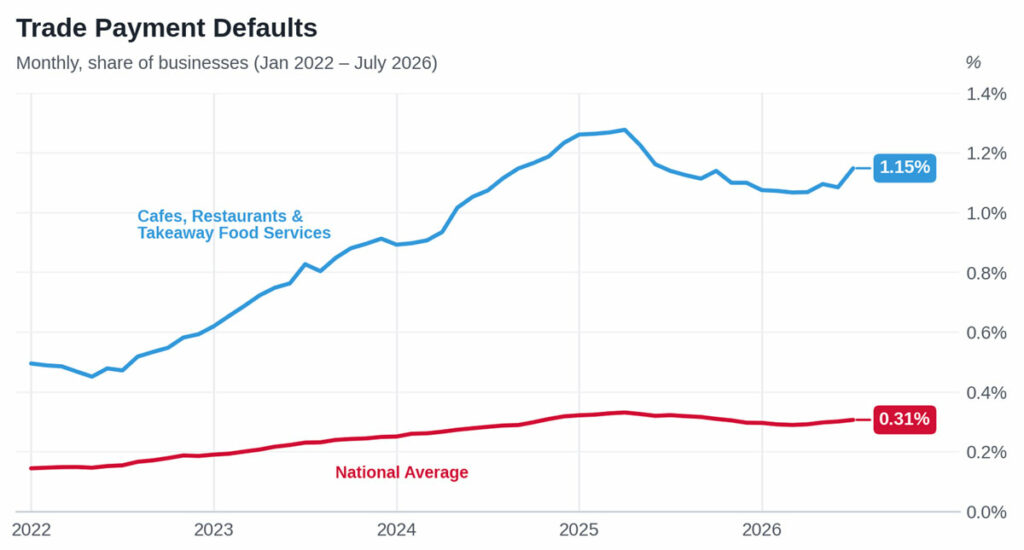
While arrears show which businesses are already under pressure, trade payment defaults point to those most at risk of failing. On this measure, hospitality also stands out: cafés, restaurants and takeaway businesses recorded a trade payment default rate of 1.15% in July 2026 - close to four times the national average of 0.31%.
This is a particularly important signal, because a trade payment default is one of the strongest forward indicators of insolvency CreditorWatch tracks. Even a single default materially raises a business's likelihood of failure over the following 12 months. A sector defaulting at around four times the national rate is not only under pressure today but likely carrying a further pipeline of failures into FY27.
Why hospitality is bearing the brunt
Economy-wide insolvencies ease but cash-flow pressure persists
Economy-wide insolvencies dropped 11.6% from June to July. The result partly reverses the broader upward trend in business failures, with the number of businesses reaching the end of their financial capacity remaining elevated.
The insolvency cycle continues to reflect the cumulative impact of a prolonged squeeze on business cash flow. Higher operating, financing and labour costs have absorbed working-capital buffers, while uneven demand has constrained the ability of many businesses to rebuild margins. These pressures do not affect every industry equally, but they have reduced the margin for error across the economy, particularly among smaller businesses with limited cash reserves and less access to external finance.
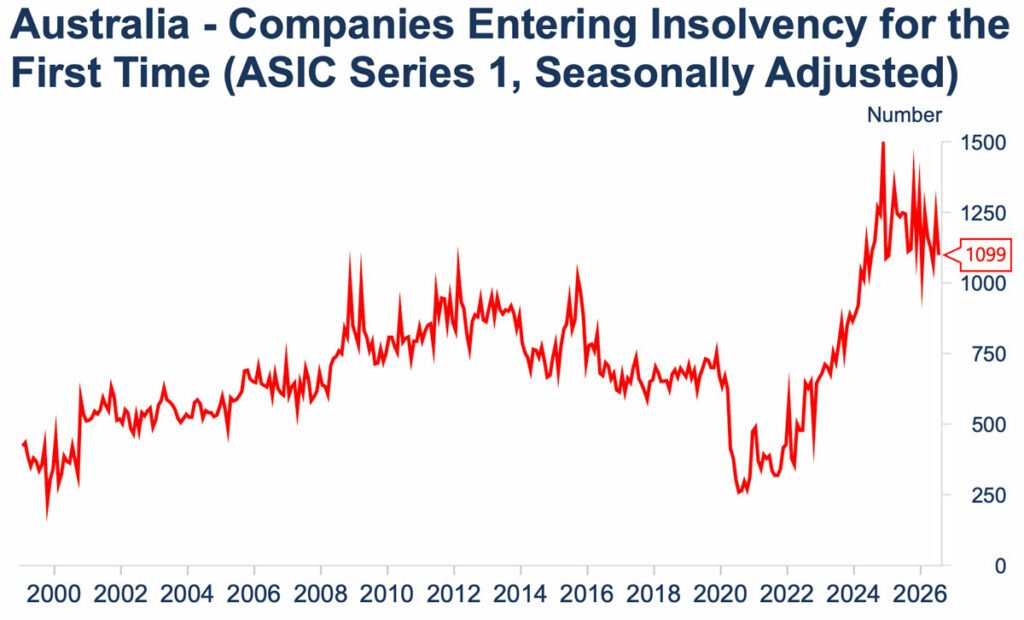
Monthly insolvency figures can be volatile, so the July movement should not be interpreted in isolation. The more important trend is whether insolvencies remain elevated over several months and whether financial stress is spreading beyond the industries that have faced the greatest pressure to date. On that basis, the operating environment remains challenging, and further business failures are likely as accumulated arrears, tax liabilities and other creditor obligations continue to crystallise.
Insolvencies are also a lagging measure of business conditions. By the time a company enters external administration, its financial position has usually been deteriorating for some time. The continued elevation of late payments and trade payment defaults therefore suggests that financial stress remains active in the business population, even if the monthly insolvency total occasionally moderates.
Rising payment defaults flash a warning for businesses
The national trade payment default rate increased to 0.31% in July, from 0.30% in June. This was the third consecutive monthly increase, taking the rate to its highest level since September 2025. The July result remains below the April 2025 peak of 0.33%, but the recent change in direction warrants attention.
The rise is modest in percentage-point terms, but trade payment defaults are an important leading indicator because they capture the point at which cash-flow pressure begins to affect a business’s ability to meet its ordinary supplier obligations. A sustained increase would indicate that financial strain is again becoming more widespread across the economy, rather than remaining concentrated in a small number of highly exposed industries.
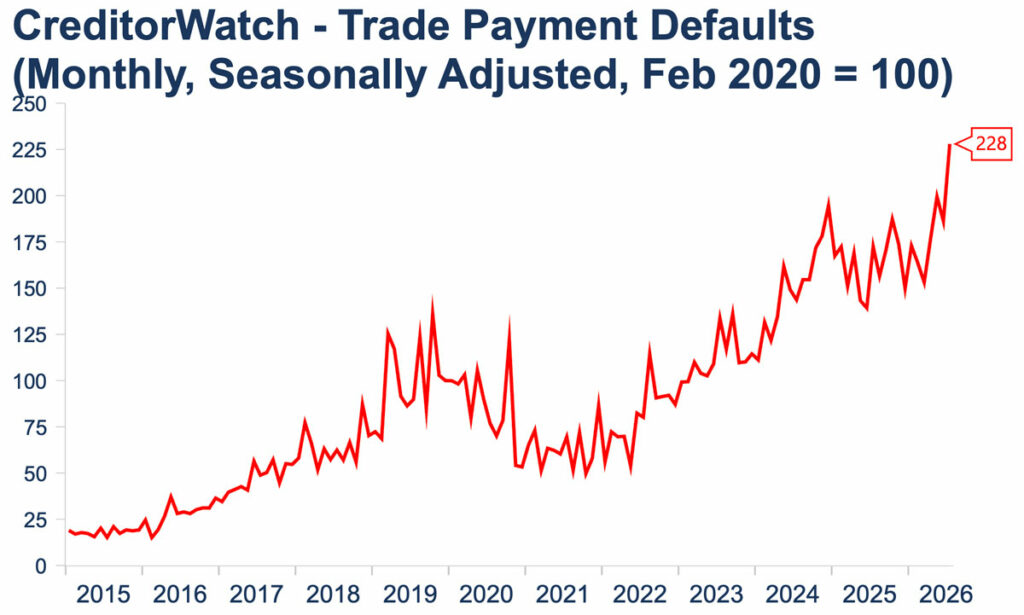
The recent trend also suggests that the improvement recorded through late 2025 and early 2026 has begun to lose momentum.
For suppliers, the critical issue is the potential flow-on effect. A missed payment weakens the creditor’s cash flow and can prompt tighter credit limits, shorter payment terms or more active collections across its customer base. If defaults continue to rise, these defensive responses can reduce the availability of informal trade credit and transmit financial pressure through supply chains.
The July result therefore reinforces the need for businesses to monitor changes in customer payment behaviour rather than relying solely on formal insolvency events or historical credit information. Defaults tend to emerge earlier in the financial-distress cycle, when creditors may still have options to review exposures, adjust trading terms and prioritise higher-risk accounts.
Our outlook
The outlook for the economy is unusually divergent by sector at the present time. Macroeconomic factors such as the recent interest rate and oil price rises, as well as continuing elevated rates of cost and wage inflation, including the Fair Work Commission’s recent higher-than-expected 4.8% award wage increase, will add to pressures in the retail and hospitality sectors in particular.
Higher interest rates and oil prices generally pressure the discretionary, interest sensitive and industrial sectors of the economy, and businesses in sectors such as Retail, Recreation and Personal Services and Manufacturing have been reporting weaker, but not exceptionally weak business conditions. At the same time, the spill-over effects from the AI investment boom are providing important support for the overall economy and especially benefiting selected parts of the Mining and Construction sectors.
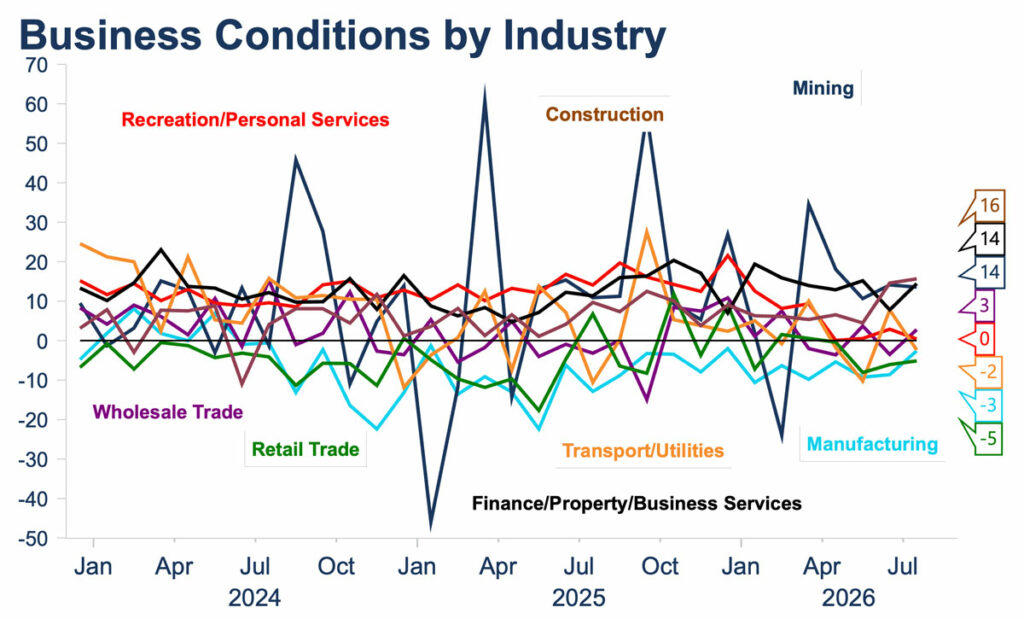
These divergences are clearly in evidence in the August monthly NAB Business Survey, with conditions in Mining, Construction and a little surprisingly Property, Finance and Business Services far stronger than all other sectors. Construction firms reported the strongest business conditions of any sector for the second consecutive month. This will help underpin overall economic growth but also makes it more likely that building materials prices will continue to rise quickly and that the pace-setting construction unions will achieve elevated pay increases.
The Real Estate sector is likely to be under additional pressure at the present time, with housing turnover and prices having softened in the wake of interest rate increases in the first half of the year and the changes announced to taxation affecting housing in the May Budget. Reductions in activity and selling prices are important drivers of increased pressures on business, just as additional costs are. While the RBA left interest rates unchanged at its August Board Meeting, the associated messaging of upside inflation risks suggests the Board remains in an active monitoring phase - some further tightening of interest rates may occur if economic growth is faster than the subdued pace the RBA requires to moderate inflation or if inflation fails to show signs of more sustainably moderating towards 2.5%.
CreditorWatch Chief Economist Ivan Colhoun says, “We forecast that some modest additional tightening of monetary policy will be required to return inflation to target, given wages growth rates remain in excess of those consistent with 2.5% inflation.
“That’s likely to add additional pressure to businesses later in the year. The RBA Board is likely to come to this conclusion in September or November. However, given inflation is only 0.75-1% above the RBA’s target - but stubbornly so - it’s not likely that significant additional tightening will be required, perhaps one or two more interest rate increases in the next six to eight months. The pathway back to more moderate inflation involves a slightly looser labour market and more moderate rates of wages and demand growth, which will continue to create the divergent economic pressures on different sectors mentioned above.”