
Australia’s data centre boom is usually told as a story about artificial intelligence, global investment and the infrastructure needed to power the next wave of technology. That is certainly true, but it is only half the story. The other half is about the people, materials and money required to build it, and what happens when those resources are already in short supply.
Australia is currently the world’s third-largest destination for data centre investment, with a development pipeline to 2030 worth more than $150 billion - a massive boon for the economy. About 91 per cent of that future pipeline is concentrated in New South Wales and Victoria. The scale of the opportunity is extraordinary. So is the strain it could place on two construction markets that are already at capacity and, in parts, financially fragile.
Data centres are not simply large sheds filled with computers. They require extensive electrical, mechanical, communications, cooling, fire-protection and commissioning work. That creates years of valuable activity for commercial builders, engineering firms, specialist contractors and suppliers. It will support jobs, investment and Australia’s ambition to participate in the AI economy.
But the boom will not lift every part of construction equally. The firms best placed to win data centre work are likely to be larger, better capitalised and equipped with specialist skills. Residential builders may receive little direct benefit while competing for many of the same workers and materials.
That matters because the housing end of construction is already under pressure. CreditorWatch’s Business Risk Index data shows that 6.5 per cent of construction invoices were more than 60 days overdue during the 12 months to August 2026. Construction had the fourth-highest arrears rate among the 18 industries measured, and that rate was 13.3 per cent higher over the year.
Construction also recorded the third-highest trade payment default rate, at 1.94 per cent, and the second-highest rate of ATO tax defaults, at 1.58 per cent. The pressure is not spread evenly. It is concentrated in residential building, where margins and cash reserves are often thinner and businesses have less room to absorb another rise in wages, materials or borrowing costs.
The latest insolvency figures underline the divide. Construction insolvencies jumped 179 per cent from July to August, reaching 815. The majority were associated with the collapse of Bathla Group, making the monthly spike unusually concentrated. Even so, the result is a stark reminder of the financial fragility already present in residential construction.
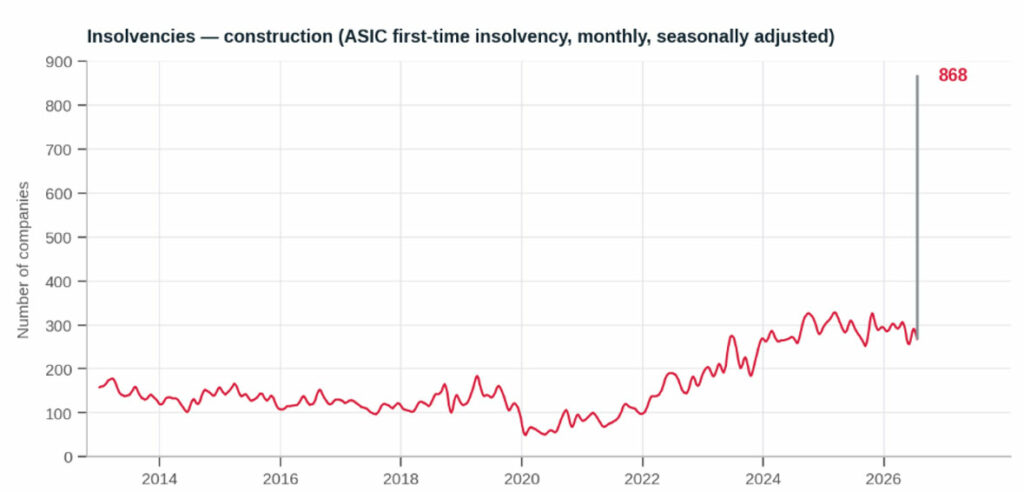
These numbers do not mean the data centre boom is bad for Australia - it is a huge positive. They show why it must be understood as a national capacity challenge, not just an investment windfall.
Australia is asking the construction industry to deliver more homes, renewable energy, transport links, essential infrastructure and now a huge new generation of data centres. Each priority is defensible. Together, they are competing for a finite pool of skilled trades, engineers, equipment and finance.
When a premium commercial project can offer attractive pay, longer contracts and highly specialised work, labour and suppliers will naturally move towards it. That can leave residential projects facing higher bids, longer delays and fewer available workers. For a builder locked into a fixed-price contract, even a modest cost increase can erase the margin on a job. A full order book can look healthy while cash flow quietly deteriorates.
This is the central risk in the two-speed construction economy. One part of the industry may be enjoying a once-in-a-generation pipeline while another absorbs the higher costs created by the same boom.
Payment behaviour gives an early view of where the pressure is building. CreditorWatch data shows that a business with four or more trade payment defaults has an insolvency rate of about 19 per cent. For a business with no registered defaults, the rate is below one per cent. Insolvency is the final event. Late and missed payments are often the warning signs that arrive earlier. That difference gives credit and AR teams a valuable window in which to act.
A change in payment behaviour should prompt questions. Is the customer taking longer to pay? Are requests for extended terms becoming more frequent? Have defaults, court actions or tax debts appeared? Is the business taking on larger, longer or more technically complex projects without a corresponding increase in working capital?
Responses may include reviewing credit limits, updating financial information, reassessing security, increasing monitoring or engaging earlier. The objective is to keep exposure appropriate as risk changes.
For policymakers, the message is broader than credit risk. Approving projects is not the same as creating the capacity to deliver them. If Australia wants the economic benefits of AI investment without worsening its housing challenge, it will need a deliberate plan to expand the construction workforce, training pipeline, energy connections and supply chains that both sectors rely on.
The debate should not become data centres versus homes. Australia needs both. The real question is whether we can grow the country’s ability to build quickly enough to avoid forcing one national priority to cannibalise another.
The $150 billion pipeline tells us where capital wants to go. It does not tell us whether the construction sector has the people, materials, infrastructure and financial resilience to turn that ambition into finished projects. Closing that gap will determine whether the data centre boom strengthens the wider economy or deepens the divides already visible within it.
Want to know more?