
Insolvency activity stabilised modestly during FY26 but a combination of higher interest rates, elevated energy costs, geopolitical uncertainty and changing business conditions suggests credit managers should prepare for a more challenging operating environment in FY27.
The year ahead will demand sharper monitoring, earlier intervention and more sophisticated risk management strategies. The economic backdrop remains highly complex. Long-term forces such as AI, climate change, demographic shifts and geopolitical tensions are reshaping global markets. At the same time, near-term risks are creating fresh challenges for Australian businesses.
The ongoing conflict involving Iran and uncertainty surrounding access to the Strait of Hormuz have increased concerns about higher fuel prices, supply disruptions and renewed inflationary pressure. Combined with persistently elevated inflation in Australia and the United States, businesses are likely to face higher borrowing costs for longer.
Insolvencies set to rise again
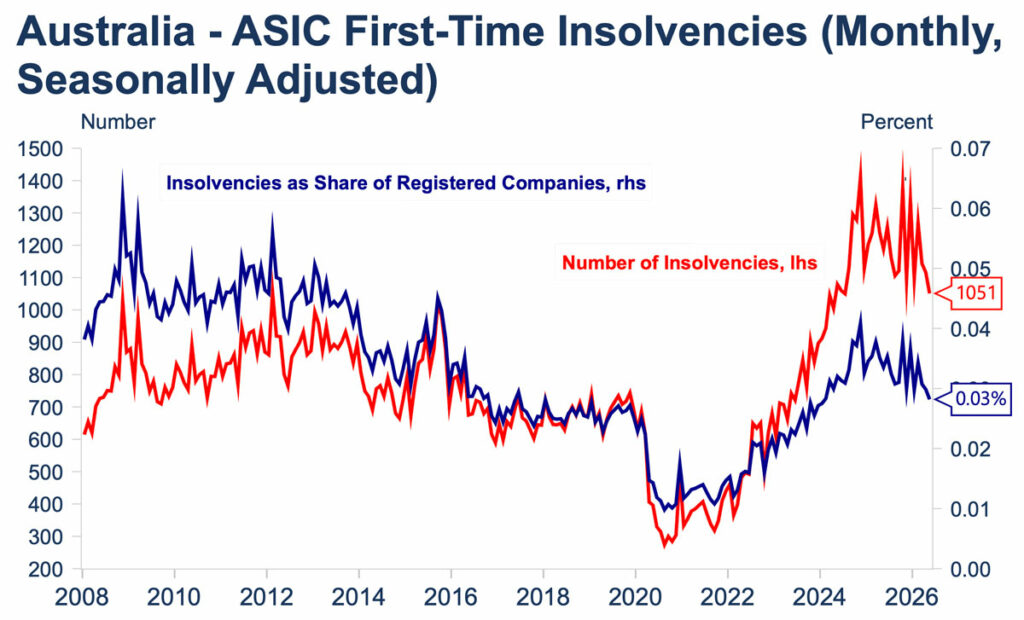
While total first-time insolvencies fell slightly during FY26, the report expects insolvencies to begin trending higher again as the cumulative impact of interest rates and operating cost pressures takes hold. Not all industries are experiencing the same level of stress. Mining, retail trade and transport recorded increases in insolvencies, while accommodation and food services experienced some improvement after several difficult years.
For credit managers, the message is clear: the operating environment is becoming increasingly sector-specific. Macro-economic indicators remain important, but industry-level analysis is essential for understanding where risk is emerging and where it is likely to intensify.
Payment defaults remain a critical early-warning signal
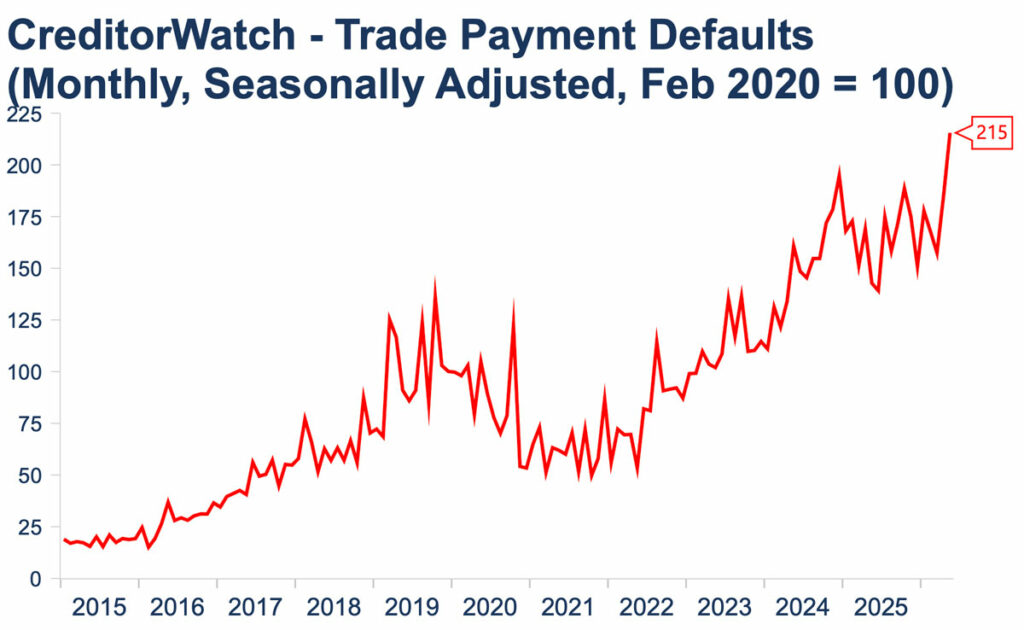
One of the report’s strongest findings is the continued predictive value of trade payment defaults. Businesses that accumulate multiple payment defaults face a substantially higher risk of insolvency than businesses with no defaults. Payment behaviour remains one of the earliest visible signs of financial distress and provides credit professionals with an opportunity to act before problems become critical.
This reinforces the importance of ongoing customer monitoring rather than relying solely on annual reviews or historical financial statements. In a rapidly changing environment, real-time indicators can provide a crucial advantage.
ATO tax debt strongly linked to failure risk
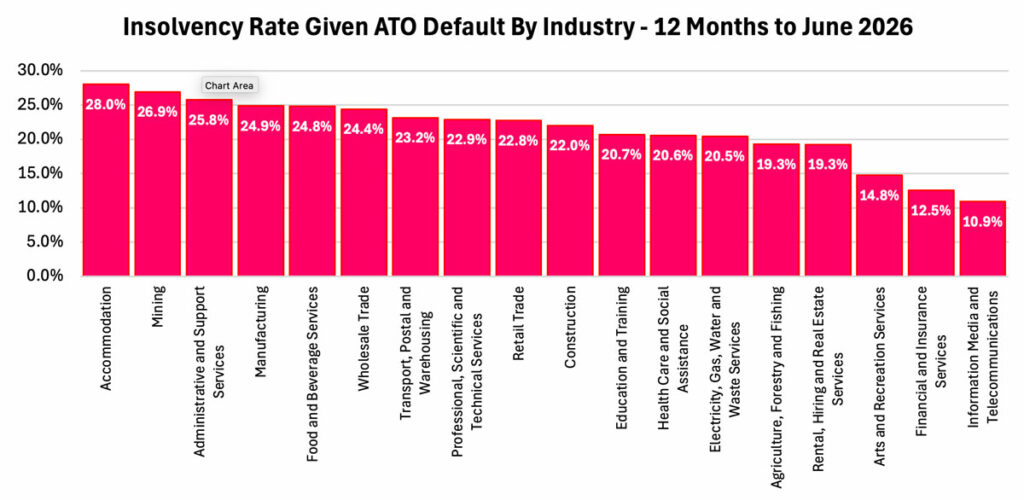
The report also highlights the growing significance of ATO tax defaults as a predictor of business failure. In many sectors, businesses carrying ATO tax debts exceeding $100,000 have a 20-30% probability of insolvency within the following 12 months. Industries including accommodation, mining, manufacturing, wholesale trade and transport all exhibit heightened vulnerability when significant tax debt is present.
For creditors, visibility over tax liabilities is becoming an increasingly valuable component of a comprehensive credit assessment framework.
New insights into asset finance risk
Perhaps the most surprising finding in the report relates to entity structure and default risk. Analysis of non-bank asset finance portfolios shows that single-director companies record a 90-plus day default rate of 6.99%, making them riskier than sole traders, which recorded a default rate of 4.70%. Risk declines consistently as the number of directors increases. Companies with five or more directors recorded a default rate of just 1.42%.
The findings suggest director count may be a stronger indicator of risk than incorporation status alone and could warrant greater consideration in credit policy and pricing decisions. The report also identifies transport as the highest-risk industry within asset finance portfolios, overtaking hospitality.
Long-haul trucking businesses in particular are showing elevated default rates, while Victorian road transport operators are experiencing additional challenges. By contrast, construction has improved and now performs slightly better than the portfolio average despite representing the largest exposure segment.
The road ahead
For AICM members, FY27 is shaping up as a year in which proactive risk management will be more important than ever. The combination of economic uncertainty, persistent inflation and rising business costs is likely to keep pressure on many organisations. At the same time, advances in predictive analytics and credit intelligence are providing lenders and suppliers with more tools to detect financial stress early.
Organisations that embrace continuous monitoring, leverage behavioural risk indicators and respond quickly to emerging warning signs will be best placed to protect cash flow and minimise bad debt in the year ahead.
Want to know more?